
- Standard price
- $34.95 a month or $249.00 a year
- First year with our link
- $199.00Then $249 a year.
- Free plan
- No free plan. Some quote pages are free to view.
- Free trial
- 7-day free trial
- Standard price
- $299.00 a year
- First year with our link
- $269.00Renews at the then-current regular price ($299 a year).
- Free plan
- Yes. Free Basic account with news, portfolios, price alerts and watchlists.
- Free trial
- 7-day free trial
Official US prices from each offer page. The deals are what our links open: click through and the discount or trial is applied there. We may earn a commission, at no extra cost to you.
Morningstar Investor and Seeking Alpha Premium are two of the best known stock research subscriptions, and both put a rating on each stock page. They get there in very different ways. Morningstar’s own analysts estimate what a company is worth. Seeking Alpha uses a data model for its Quant Rating and adds articles from many investors and analysts.
This page compares the two side by side: how the ratings work, what each costs, which markets they cover and who each one suits. Every fact comes from the official Morningstar and Seeking Alpha pages, read on 3 Nov 2026. It is general information, not advice on what to buy.
Morningstar suits long-term investors who want an independent estimate of what a company is worth, while Seeking Alpha suits investors in US stocks who want a quick data-driven rating plus written arguments for and against.
The main difference: analysts against a data model
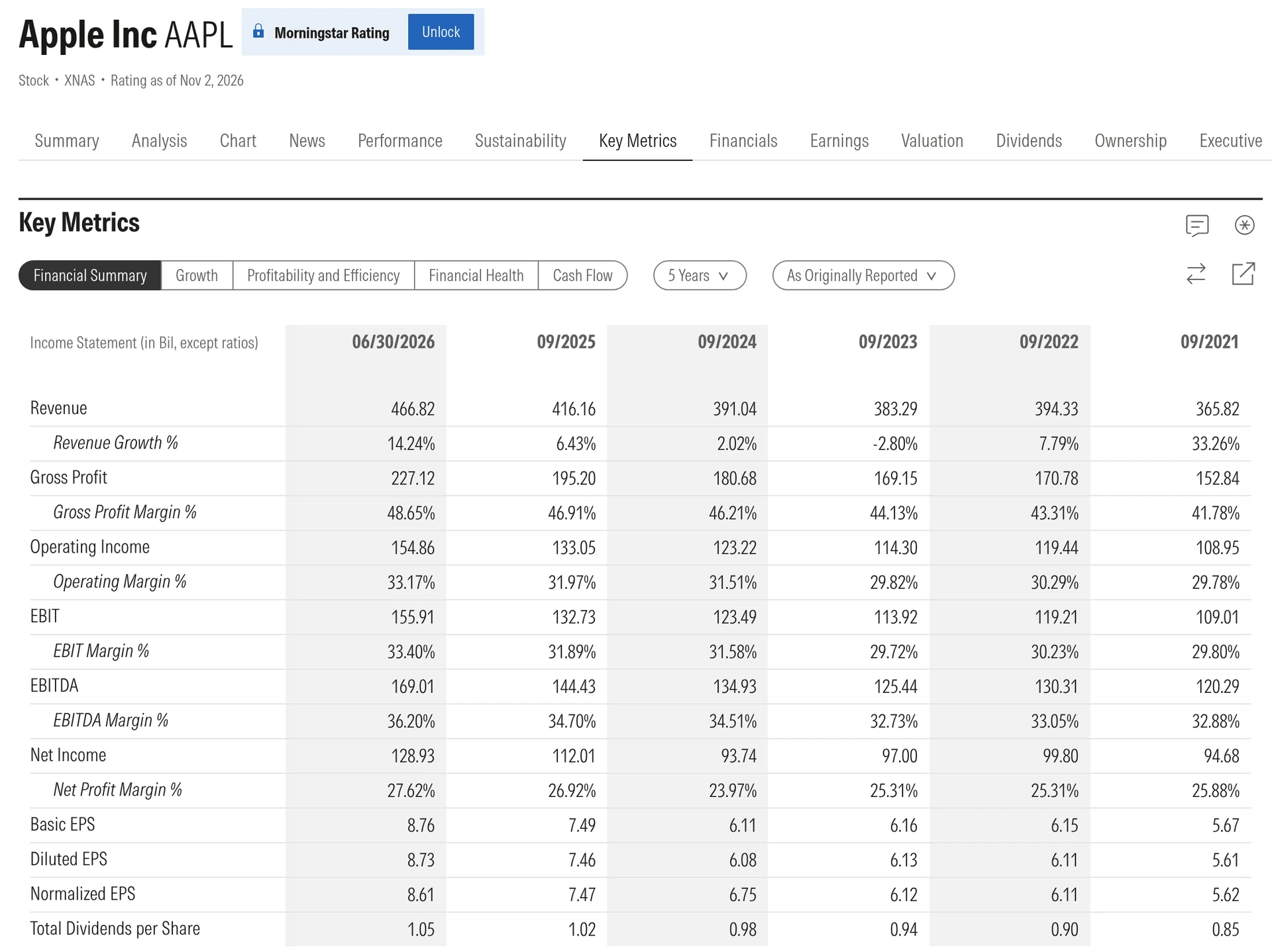
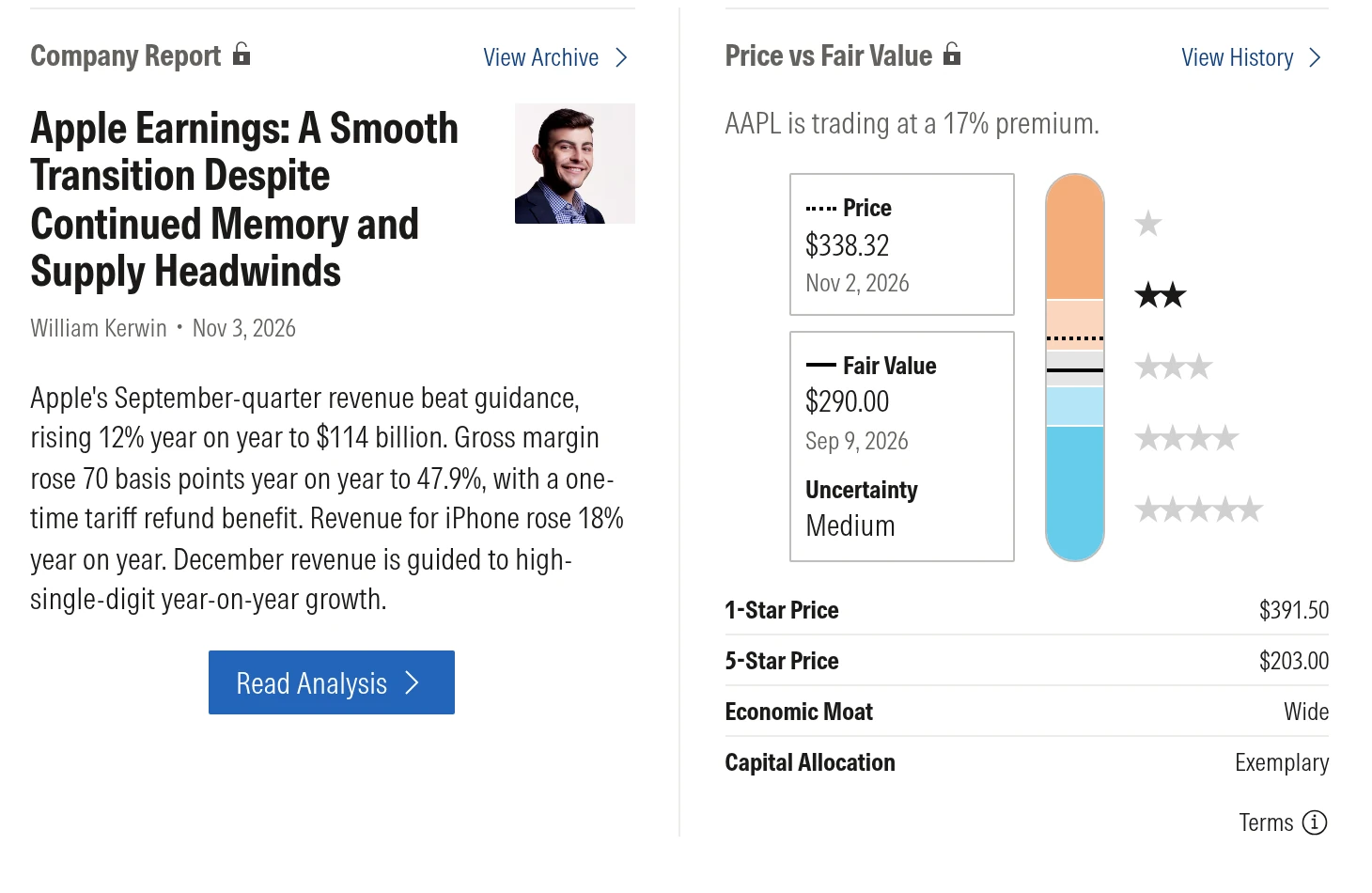
Morningstar is built around its own analysts. For the stocks they cover, Morningstar publishes three ratings:
- a fair value estimate, based on how much cash Morningstar expects the company to generate in future;
- an economic moat rating, which measures how durable the company’s competitive advantage is;
- a star rating from 1 to 5, which compares the share price with the fair value estimate and takes the uncertainty of that estimate into account.
The full company report explains the view in words, including a Bulls Say and Bears Say section with the case for and against (how Morningstar’s stock ratings work, company reports).
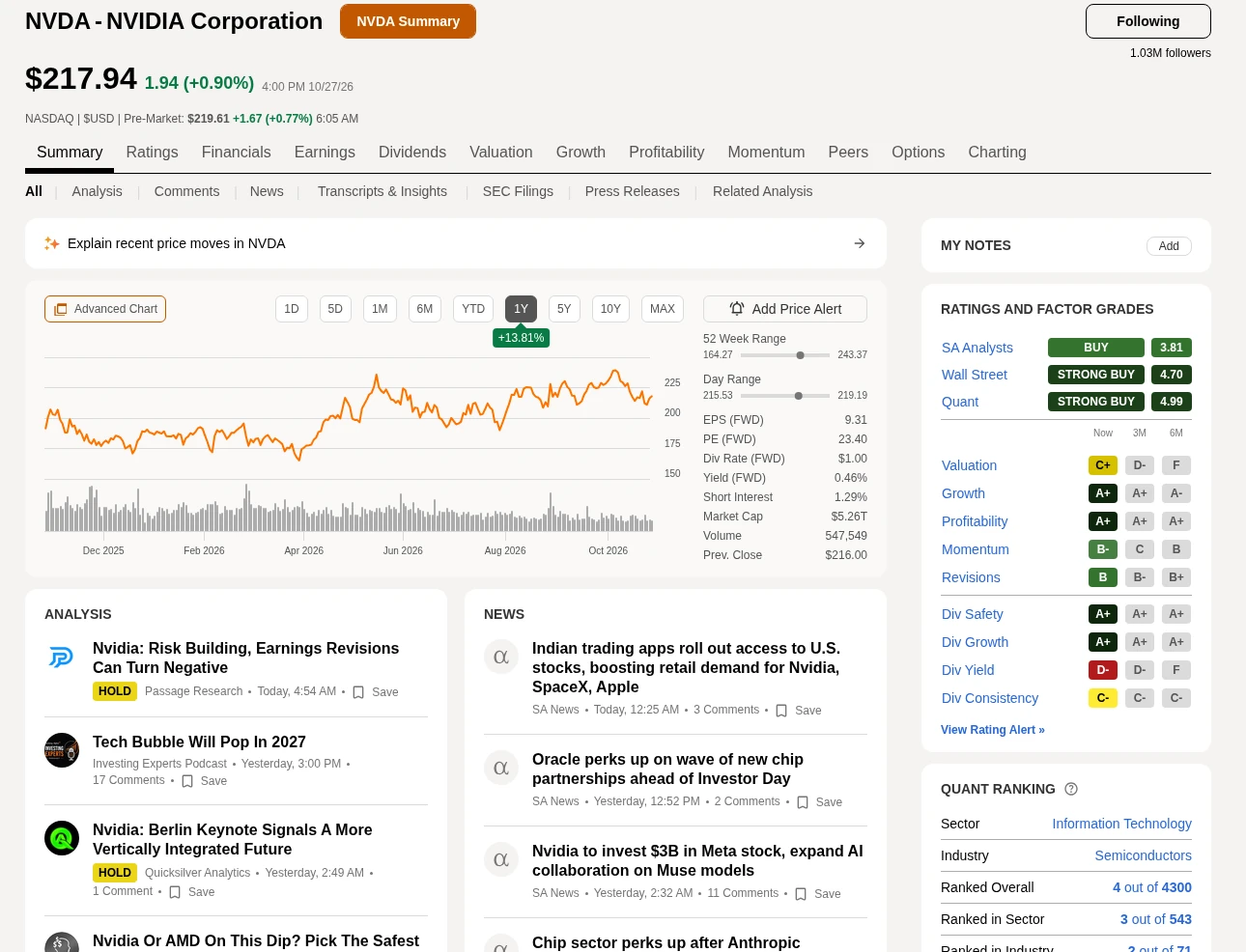
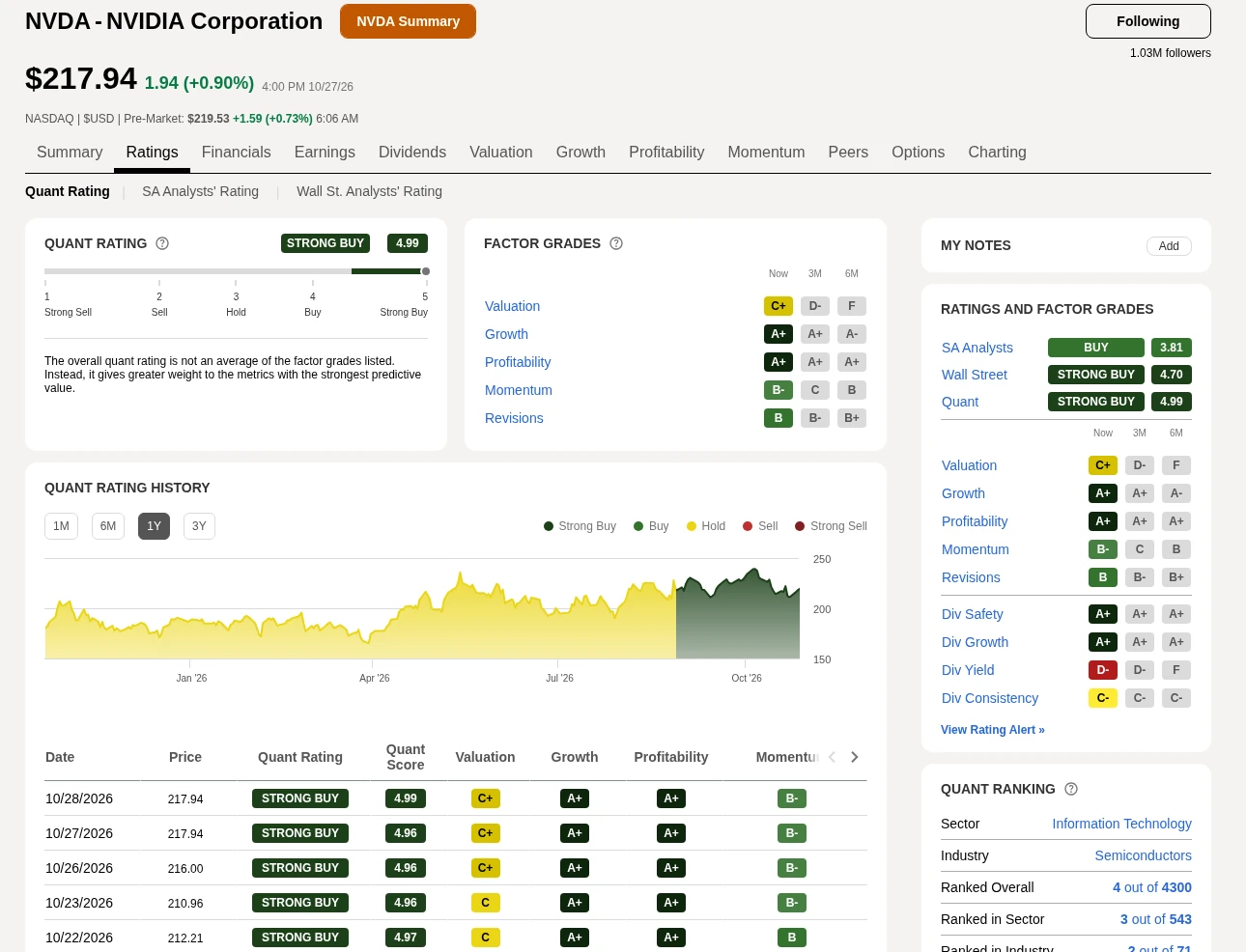
Seeking Alpha puts two things on one stock page. The Quant Rating is built from financial statements, price performance and analyst estimates. Seeking Alpha says it covers about 5,600 stocks and updates once a day. Five Factor Grades (Value, Growth, Profitability, Momentum and EPS Revisions) compare a stock with others in its sector. Next to the ratings you can read articles from contributors and analysts (Quant Ratings and Factor Grades).
So the question is mostly what kind of help you want. Morningstar gives you one independent estimate of value and the reasoning behind it. Seeking Alpha gives you a fast, data-driven grade and many opinions to weigh.
Side by side
| Morningstar Investor | Seeking Alpha Premium | |
|---|---|---|
| Main rating | Star rating, fair value estimate and moat rating from Morningstar’s analysts | Quant Rating and five Factor Grades from a data model |
| Written analysis | Full company reports from Morningstar’s analysts | Articles from many contributors and analysts |
| Free way in | No free plan. 7-day free trial, one per person | Free Basic account. 7-day free trial of Premium for new subscribers |
| Standard price | USD 34.95 a month or USD 249 a year | USD 299 a year (billed yearly) |
| Offer through our links | USD 199 for the first year of the yearly plan | USD 269 for the first year |
| Funds and ETFs | Funds and ETFs get star ratings and a Medalist Rating, and you can screen them | Covers US-listed stocks and ETFs. No fund rating like the Medalist Rating on the pages we checked |
| Markets with ratings | US, plus London and Xetra pages with fair values we opened. UAE stocks get automated Quantitative Ratings only | US-listed stocks and ADRs only |
| Screener | Stocks, ETFs, mutual funds and closed-end funds, 200+ data points, AI Quick Filters | About 100 criteria, including Quant Ratings and Factor Grades |
| Portfolio tools | X-Ray for fees, sectors and regions, Stock Intersection for overlap, account linking | Portfolios on the free account; Premium can link US brokers |
Prices are in US dollars, as shown on the official pages on 3 Nov 2026, and can change. Sources: Morningstar offer page, Morningstar standard prices, Seeking Alpha offer page.
Prices and trials
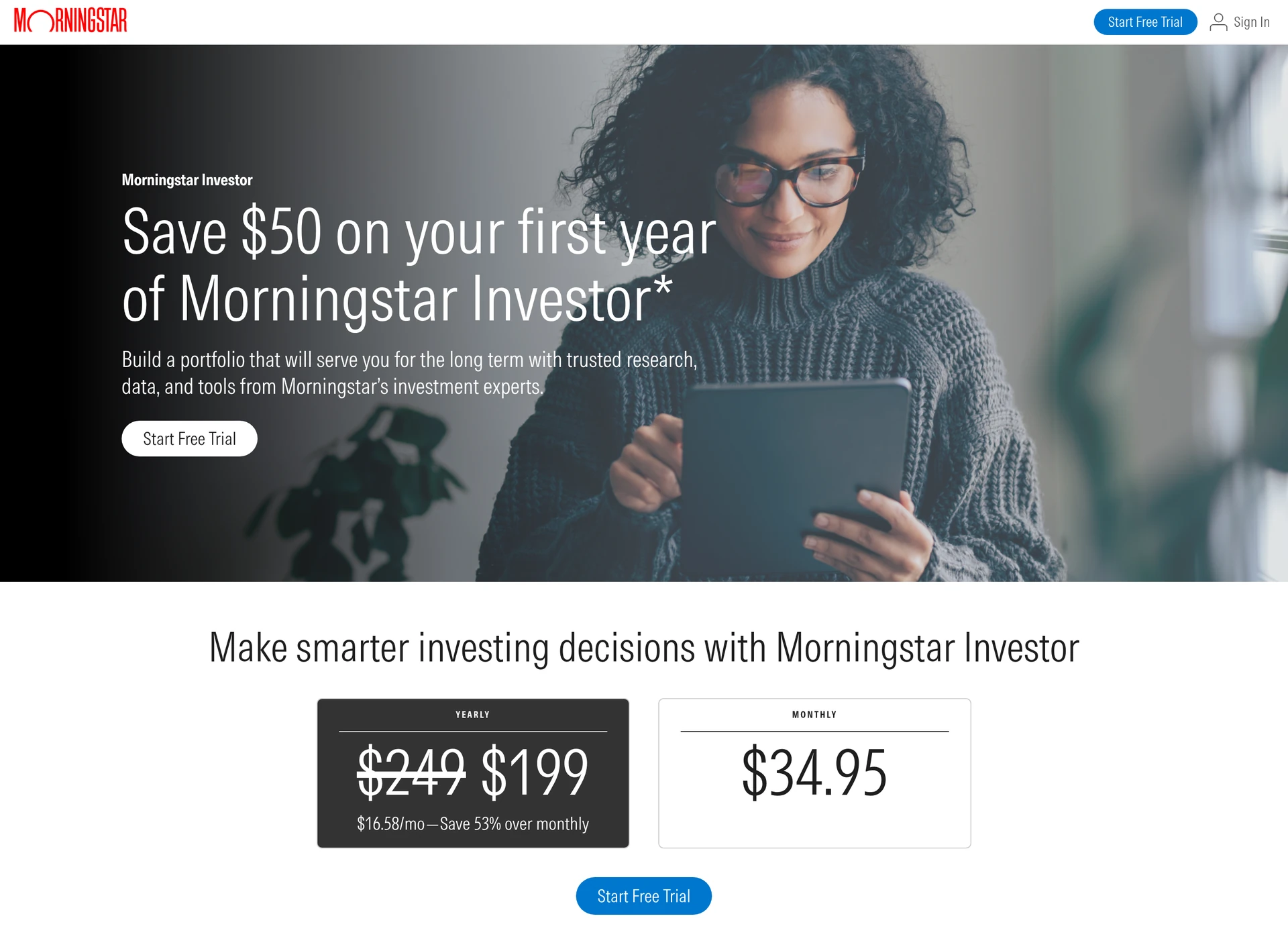
Morningstar Investor costs USD 34.95 a month or USD 249 a year. Through the offer page our links open, the first year of the yearly plan is USD 199, a saving of USD 50. Morningstar says this offer is only for the first year of a yearly subscription, cannot be combined with another offer and cannot extend an existing subscription. The 7-day free trial ends at 11:59 PM Central Time on day seven, and Morningstar allows one trial per person. In the US, Morningstar also lists discounts for students, teachers and military members (discounts).
Try Morningstar Investor free for 7 days
Seeking Alpha Premium has a 7-day free trial for new subscribers. After the trial, the offer page our links open charges USD 269 for the first year, then it renews at the then-current yearly list price, which is USD 299 today. Premium is billed yearly. If you only want news, portfolios, price alerts and watchlists, the free Basic account may be enough.
Try Seeking Alpha Premium free for 7 days
If you want to pay month by month, only Morningstar offers that here. Seeking Alpha Premium is billed yearly after the trial.
Markets: who covers stocks outside the US?
This matters if you live in the UK, Europe or the UAE.
- Seeking Alpha’s Quant Ratings cover US-listed stocks and ADRs only. ADRs let some foreign companies trade in the US, but local listings in London, Frankfurt or Dubai are not rated.
- Morningstar has stock pages for many markets. On public pages we opened, London (Vodafone) and Xetra (SAP) stocks showed fair value estimates. Dubai and Abu Dhabi stocks had pages with automated Quantitative Ratings, not analyst ratings.
For a portfolio of US stocks, both work. For a mixed portfolio with London or European shares, Morningstar covers more of it.
Funds and ETFs
If you hold funds and ETFs as well as stocks, this is where Morningstar stands apart. Funds get a star rating from 1 to 5, which is purely backward-looking and measures how a fund has performed against similar funds. The Medalist Rating (Gold, Silver, Bronze, Neutral or Negative) is forward-looking and shows how confident Morningstar is that a fund can beat its benchmark or peer group (fund ratings).
Morningstar’s portfolio tools are built for this too. X-Ray shows your whole portfolio by asset class, stock sector and world region, plus the weighted average expense ratio of your funds (X-Ray). Stock Intersection shows the top 50 stocks you hold across all your funds and ETFs, so you can see when two funds own the same companies (Stock Intersection).
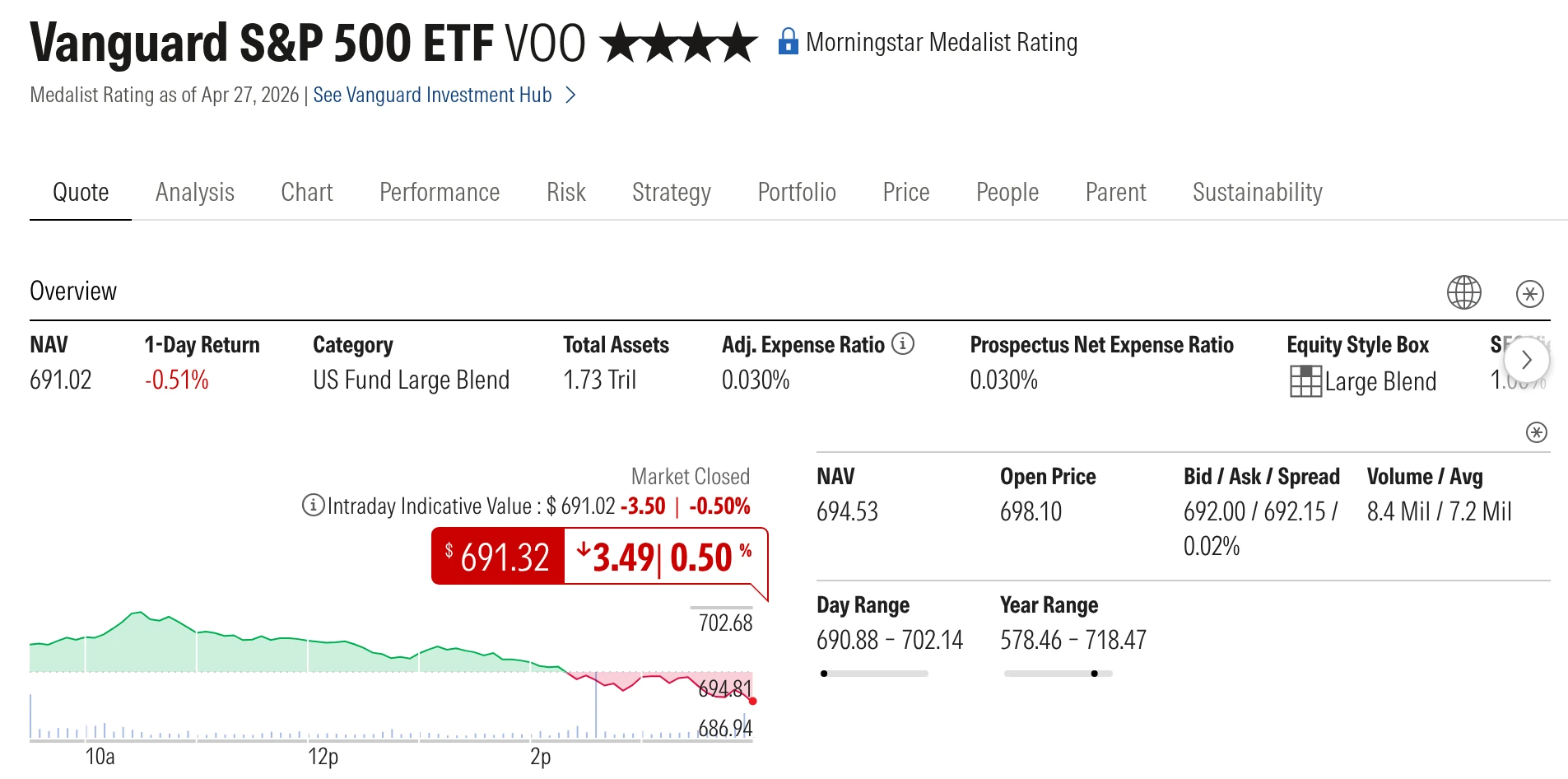
Seeking Alpha’s strength is single US stocks. It covers US-listed ETFs too, but we did not find a fund rating like Morningstar’s Medalist Rating on its official pages.
Screeners
Both have a screener on the paid plan.
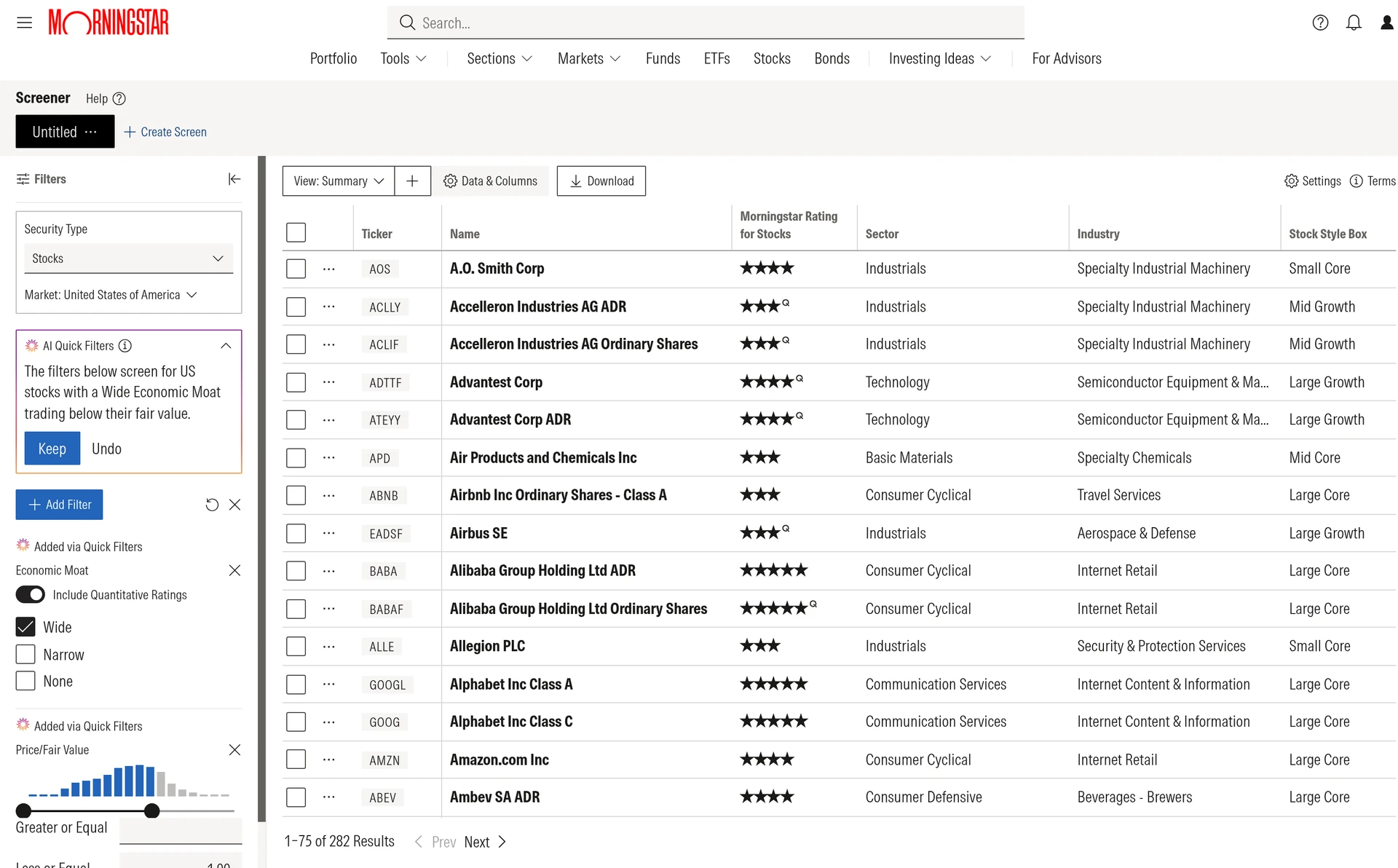
- Morningstar lets you filter stocks, ETFs, mutual funds and closed-end funds, and sort by its own ratings. You can start from its Best Investments lists or type a request in plain words with AI Quick Filters, such as “Five star stocks with a dividend yield above 3%”. Morningstar notes that the AI can make mistakes, so check the filters it sets (AI Quick Filters).
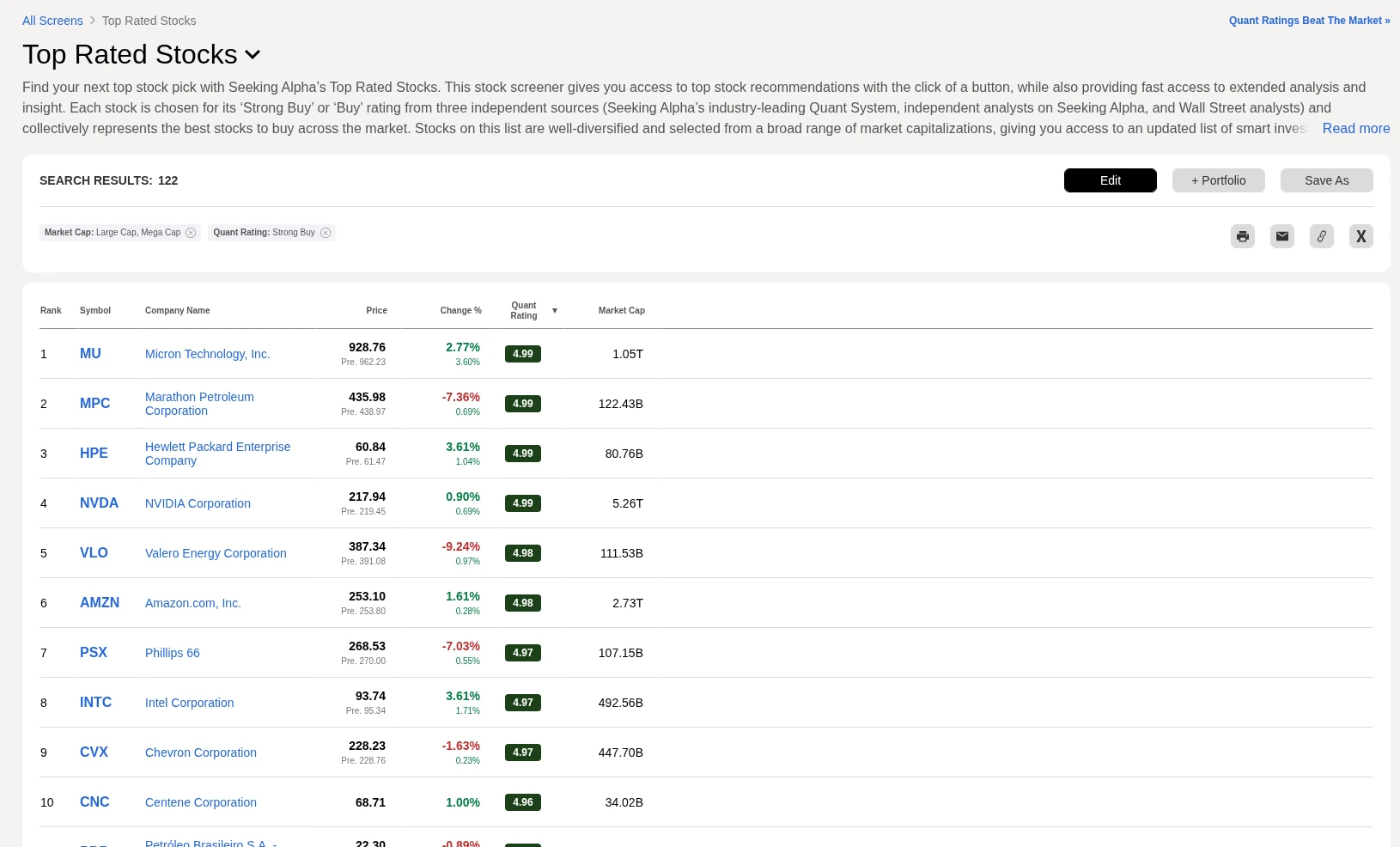
- Seeking Alpha Premium lets you build and save screens with about 100 criteria, including the Quant Rating, the ratings of Seeking Alpha authors and Wall Street analysts, and the Factor Grades (Seeking Alpha screeners).
For more on screening, see our stock screener guide.
Who each one suits
Morningstar Investor may suit you if:
- you invest for the long term and want an independent estimate of what a company is worth;
- you like to read one analyst’s full reasoning, including the case against;
- you hold funds and ETFs and want to see fees and overlap across them;
- you hold some London or European shares;
- you want monthly billing.
Seeking Alpha Premium may suit you if:
- you mainly buy US stocks;
- you want a quick grade that sums up value, growth, profitability, momentum and estimate changes;
- you like reading several opinions on a stock before you decide;
- you want to start with a free account before paying.
Some investors use both: Seeking Alpha to find and read about US ideas, and Morningstar to check a fair value and to look after a fund portfolio. Try one at a time with its free trial, and cancel before the trial ends if it does not fit.
A word on ratings
A star rating, a fair value or a Quant Rating is the provider’s opinion or model output. It can be wrong, it changes as prices and data change, and it does not know your goals or situation. Use ratings as a starting point for your own research, not as a reason to buy or sell.
Frequently asked questions
Is Morningstar or Seeking Alpha better for beginners?
It depends on what you invest in. Morningstar’s star rating and fair value are easy to read, and the reports explain the reasoning. Seeking Alpha’s Factor Grades are also simple to read, and you can start with the free Basic account. Neither tells you what to buy.
Is there a free version of either?
Seeking Alpha has a free Basic account with news, portfolios, price alerts, watchlists and one free Premium article. Morningstar Investor has no free plan, but some Morningstar quote pages are public and there is a 7-day free trial.
Which is cheaper?
On the first-year offers our links open, Morningstar costs USD 199 for the first year of the yearly plan and Seeking Alpha Premium USD 269. At standard prices, Morningstar is USD 249 a year and Seeking Alpha Premium USD 299 a year. Morningstar also has a monthly plan at USD 34.95.
Can I use either for UK or European stocks?
Morningstar shows fair value estimates on some London and Xetra stock pages we opened. Seeking Alpha’s Quant Ratings only cover US-listed stocks and ADRs.
Where can I read more?
See our full Morningstar review and Seeking Alpha review, or the ranking of research platforms. If you are also looking at stock pick newsletters, see Seeking Alpha vs Motley Fool.
Full prices and deals
| What | Morningstar Investor | Seeking Alpha |
|---|---|---|
| Score | Number 4 of 11 in stock research platforms | |
| Plan | Investor | Premium |
| Monthly price | $34.95 a month | No monthly plan, billed yearly |
| Yearly price | $249.00 a year | $299.00 a year |
| First year with our link | $199.00Save $50 | $269.00Save $30 |
| After the first year | Then $249 a year. | Renews at the then-current regular price ($299 a year). |
| Free trial | 7-day free trial | 7-day free trial |
| Free plan | No free plan. Some quote pages are free to view. | Yes. Free Basic account with news, portfolios, price alerts and watchlists. |
| Deal | Get the deal | Get the deal |
Other Seeking Alpha plans and prices
- Alpha Picks:USD 449 for the first year, then USD 499 a year. No free trial. Sold separately from Premium.
- Premium + Alpha Picks bundle:USD 629 for the first year, against USD 798 for both plans at the regular price (save USD 169). Then each plan renews at its regular price.
- PRO:USD 89 for a 1-month paid trial, then USD 2,149 for the first year. Renews at the regular price (USD 2,400 a year).
- Quant Growth & Income:USD 449 for the first year, charged immediately. Then USD 499 a year. Does not include Premium or Alpha Picks.
- Alpha Picks + Quant Growth & Income bundle:USD 719 for the first year, against USD 998 for both at the regular price. Does not include Premium.
Research, not advice. This article explains how tools work. It is general information, not a recommendation to buy or sell any investment, and not personal advice. Investing puts your capital at risk and you can get back less than you put in. Prices and plans change, so check the official site before you pay.
Some links on this page are affiliate links. If you subscribe through them we may earn a commission, at no extra cost to you. We score every tool on the same published criteria, using facts from official pages and our own testing. How we make money. This page is general information, not personal investment advice.
Read next
 ReviewMorningstar Investor reviewIndependent analyst ratings and fair values with a 7-day trial. No free plan.Read the review
 ReviewSeeking Alpha reviewBest for reading analysis and ratings on US stocks in one place. Weak for non-US stocks.Read the review
 ArticleStock screener guide: how to use one, and which screeners to tryWhat a stock screener is, what the filters mean in plain English, how to build your first screen, and what the free and paid screeners we review offer.Read the article ArticleWhat is a stock research platform, and how do you choose one?A plain-English explainer: what stock and investment research platforms do, what is inside them, how they differ from a broker app, and a simple checklist for choosing one.Read the article