



A halal stock screener checks whether a company’s shares fit Islamic finance rules. It looks at what the company does to earn money and at how much debt and interest it carries. Musaffa, Zoya and Islamicly are three of the best known apps that do this for everyday investors.
This guide explains how each halal stock screener works, what it checks, what is free and what you pay for. Facts come from each company’s own methodology and help pages, read on 4 Nov 2026. We are not Islamic scholars, and this page is not a religious ruling or financial advice. Screeners can reach different results for the same company, so check with a scholar you trust about what is right for you.
All three apps follow standards based on AAOIFI, the body that publishes Shariah standards for Islamic finance, but none of them can tell you whether a stock is a good investment.
How a halal stock screener works
Most screeners use two steps.
- Business screen. The company’s main business must be permissible. Companies whose core business is, for example, alcohol, gambling, pork, tobacco, adult content or conventional interest-based finance fail. A company can still pass if a small part of its revenue comes from such activities, usually under 5%.
- Financial screen. The company must not rely too much on interest. Screeners compare its interest-bearing debt, and its cash and interest-bearing investments, with the size of the company. Under AAOIFI-based rules the usual limit is 30% for each.
A third idea is purification. If a company that passes earns a small share of its revenue from impermissible sources, many investors give that share of their dividends or gains to charity. Screeners differ on how they calculate this.
The three screeners at a glance
| Musaffa | Zoya | Islamicly | |
|---|---|---|---|
| Standard | AAOIFI | AAOIFI by default; Pro adds S&P, MSCI, Dow Jones and FTSE Russell methodologies | Its own Shariah Advisory Board, “in convergence with AAOIFI rules” |
| Revenue limit | Impermissible income under 5% of total revenue | Under 5% of revenue | Under 5% of revenue, including all interest income |
| Debt limit | Interest-bearing debt under 30% of the 36-month average market value | Interest-bearing debt under 30% of market cap (AAOIFI) | Debt under 30% of the 36-month average market value |
| Cash and interest assets limit | Interest-bearing assets under 30% of the 36-month average market value | Interest-bearing assets under 30% of market cap (AAOIFI) | Cash and interest-bearing securities under 30% of the 36-month average market value |
| Purification | Calculator on stock pages; automated purification for linked portfolios | Purification guidance; impermissible revenue shown in the app | Dividend purification ratio on each report |
| Free plan | Yes | Yes, status only under AAOIFI | Free report card |
| Paid price | Not shown on the public pricing page | See below | Not shown without signing in |
Sources: Musaffa screening methodology, Zoya screening help article, Islamicly screening process, all read on 4 Nov 2026.
Musaffa
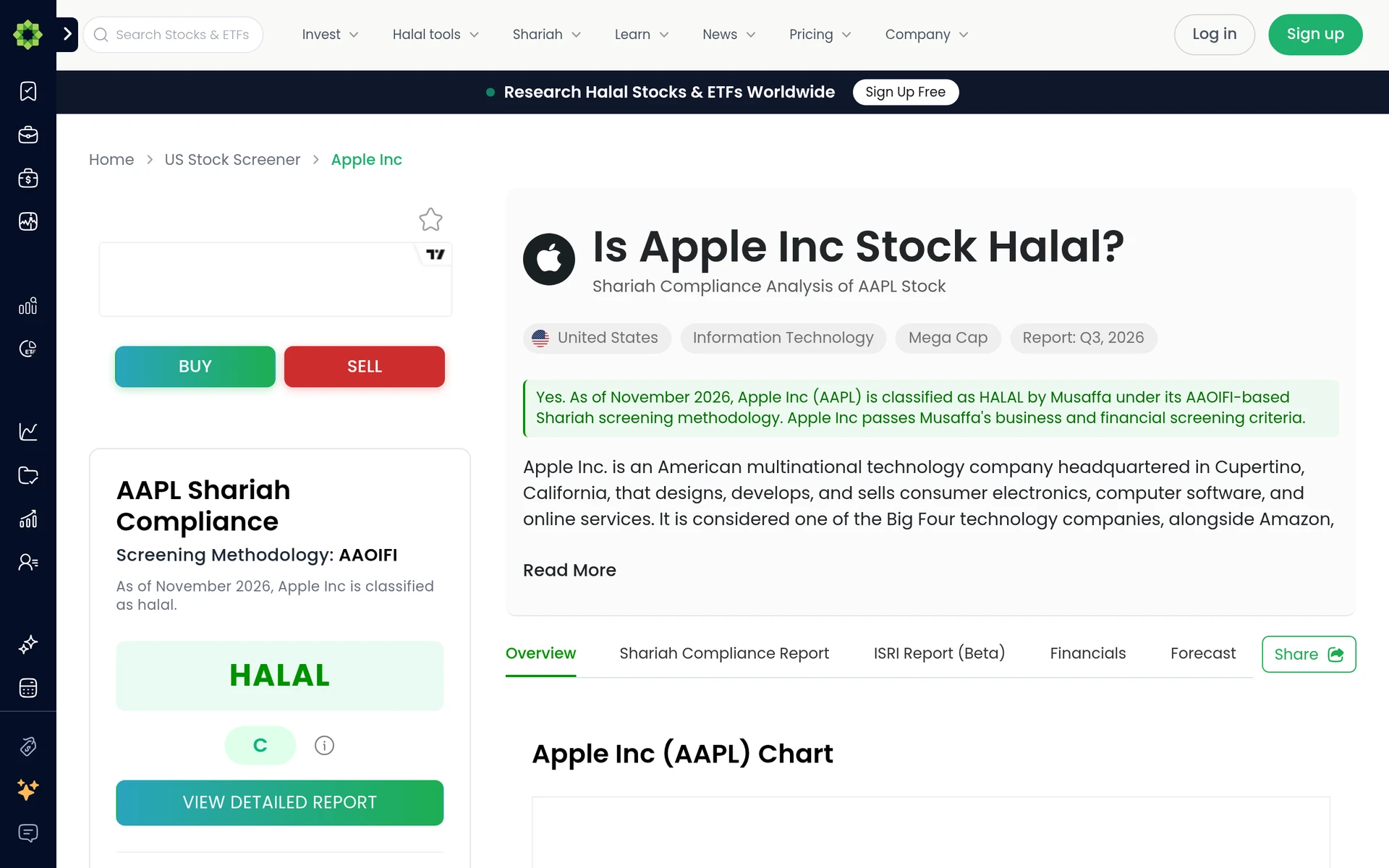
Musaffa says its screening follows AAOIFI standards and is certified by Amanah Advisors. Its methodology page names Shaikh Dr. Aznan Hasan, a member of the AAOIFI Shariah Board, and Mufti Faraz Adam as Shariah advisors.
- Business screen: Musaffa lists non-halal food, alcohol, gambling, adult content, tobacco, marijuana, weapons, cloning and interest-based finance among the activities it checks.
- Financial screen: three ratios. Impermissible income must be under 5% of total revenue. Interest-bearing assets and interest-bearing debt must each be under 30% of the company’s trailing 36-month average market value.
- Results: each stock is shown as Halal, Doubtful or Not Halal, with a letter rating. Musaffa also screens ETFs and sukuk.
- Purification and zakat: stock pages include a purification calculator. Musaffa’s pricing page lists manual purification and zakat calculators, and purification and zakat for broker-linked portfolios. Some of these need Premium.
- Price: Musaffa’s pricing page shows a Free plan and one Premium plan, billed monthly or yearly. It did not show a Premium price on the public page when we checked, so see the app for today’s price.
Zoya
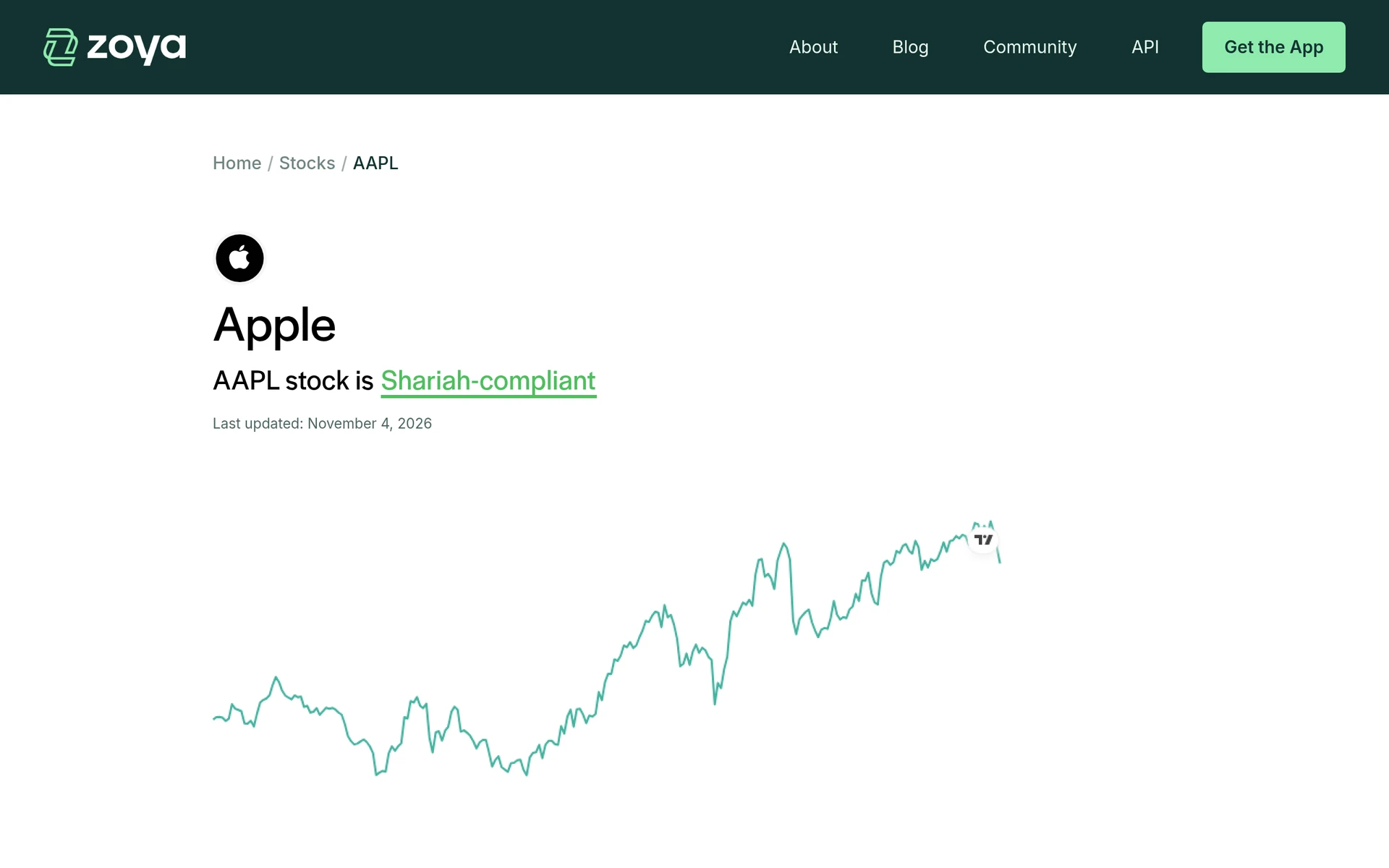
Zoya’s help centre says it screens stocks under AAOIFI standards by default. Pro users can also switch to methodologies used by S&P Shariah, MSCI Islamic, Dow Jones Islamic and FTSE Russell Shariah indexes. Zoya says it is not affiliated with these organisations, its results may differ from theirs, and a stock can pass under one standard and fail under another.
- Business screen: revenue from impermissible activities must be under 5%.
- Financial screen: under AAOIFI, interest-bearing debt and interest-bearing assets must each be under 30% of market cap.
- Results: stocks are shown as compliant, non-compliant or questionable.
- Free plan: compliance status under AAOIFI only, the top 10 holdings of funds, 1 linked account and a watchlist of up to 200.
- Pro: full compliance reports, all methodologies, all fund holdings, unlimited linked accounts, a bigger watchlist, alerts, advanced filters and export.
- Price: a Zoya help article lists Pro at USD 14.99 a month or USD 119.99 a year in the US, and says prices may differ in other countries. That article was last updated in Aug 2023, so check the app store for today’s price.
Zoya screening help article, what is in Zoya Pro, Zoya Pro price
Islamicly
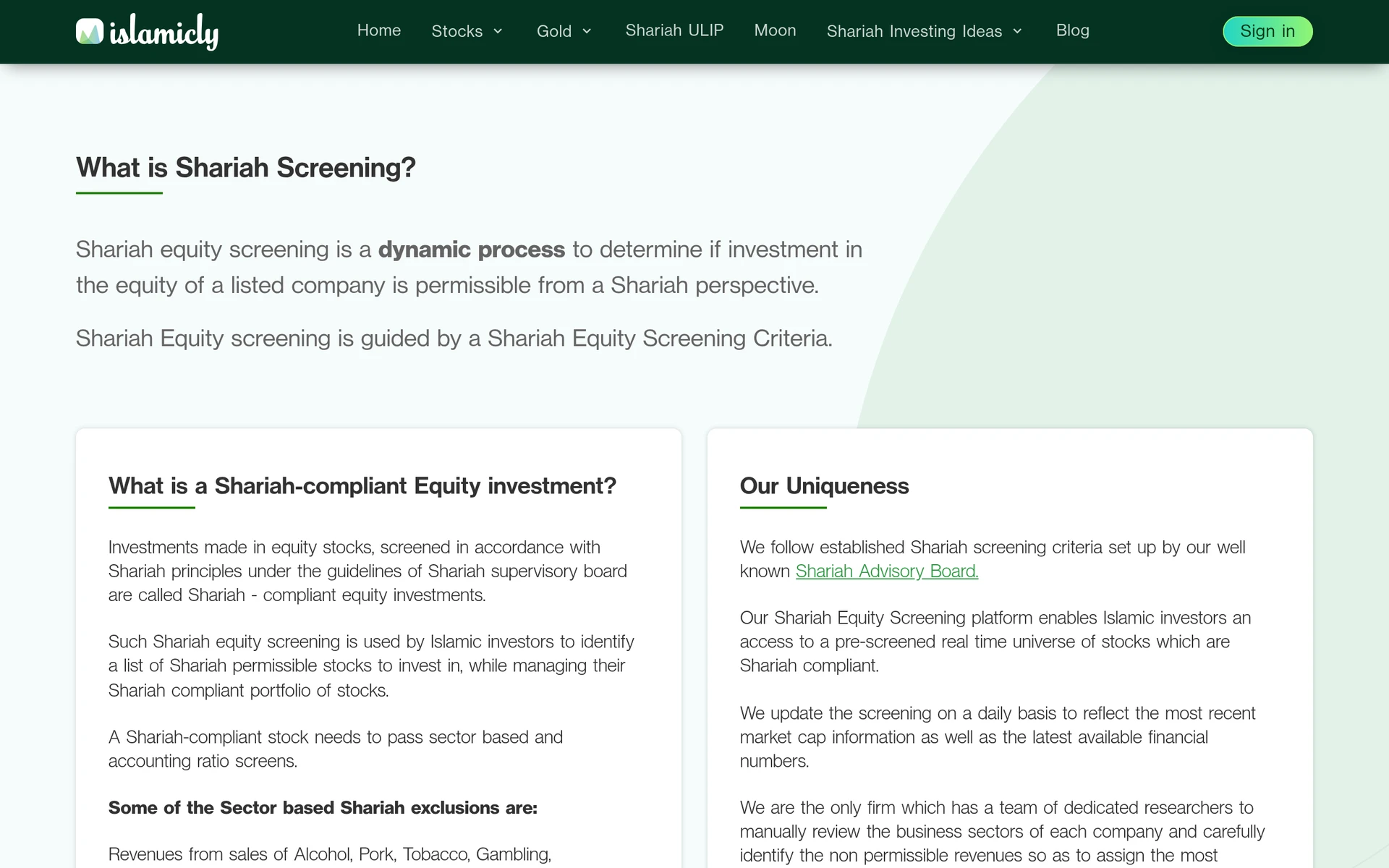
Islamicly says its criteria are set by its in-house Shariah Advisory Board, in line with AAOIFI rules. Its homepage names Dr. Mohamed A. Elgari as Chairman, with Dr. Nazih Hammad and Dr. Muhammad Amin Qattan. It describes three levels of screening.
- Business sector screening: it excludes alcohol, financial services, gambling, pork, pornography, tobacco, advertising, media and entertainment, and gold and silver traded on a deferred basis.
- Financial ratio screening: revenue from those activities, including all interest income, must be under 5% of total revenue. Debt, and cash plus interest-bearing securities, must each be under 30% of the 36-month average market value of the company.
- Dividend purification: each report shows a purification ratio. Islamicly’s example: if the ratio is 10%, then 10% of the dividend goes to charity.
- Updates: Islamicly says screening is updated daily, with a research team checking data by hand.
- Price: Islamicly offers a free report card. Its paid plans need a sign-in to view, so we could not check the price.
Why screeners can disagree
The three apps follow similar rules, but you can still see different answers for the same company. Common reasons:
- Different measures of size. Some compare debt with the 36-month average market value, others with current market cap. When a share price moves a lot, the result can change.
- Different lists of excluded businesses. Islamicly, for example, lists advertising and media among its exclusions.
- Different data and update times. Each app reads company reports on its own schedule, so a status can lag a new report.
- Different methodologies. Zoya shows that a stock can pass under one index standard and fail under another.
If two apps disagree, read both reports, see which test the company fails, and ask a scholar you trust.
How to choose a halal stock screener
- Start free. All three have a free way to look up a stock’s status.
- Check the market you invest in. Musaffa says its research covers 150+ markets. Zoya lists the US, UK, Canada, Australia, Germany, India, Japan, Poland and Taiwan for stocks, with funds in the US only.
- Decide whether you need more than one standard. Zoya Pro lets you compare methodologies.
- Look at purification tools if you get dividends.
- Remember what a screen does not tell you. A halal status says nothing about whether a company is a good investment or whether its price is fair.
For general stock research, see our best stock screeners ranking and our stock screener guide. Our methodology page explains how we test tools, and the tool finder can suggest a research tool for your needs.
A word on screens and advice
A screen is one company’s reading of a set of rules. It is not a religious ruling, and it is not a signal to buy or sell. Rules and data can change from one quarter to the next. Check with a scholar you trust about what is permissible for you, and remember that you can lose money on any investment.
Frequently asked questions
What is a halal stock screener?
A halal stock screener is an app or website that checks whether a company’s shares fit Islamic finance rules. It looks at the company’s business activities and at financial ratios for debt and interest. Musaffa, Zoya and Islamicly are three examples.
Which is the best halal stock screener?
It depends on what you need. Musaffa covers 150+ markets and lists purification and zakat tools. Zoya lets Pro users compare several methodologies. Islamicly is run by its own Shariah Advisory Board and has a free report card. All three base their rules on AAOIFI standards.
Is the Zoya app free?
Zoya has a free plan that shows a stock’s compliance status under AAOIFI standards, the top 10 holdings of funds and a watchlist. Zoya Pro adds full reports, other methodologies, alerts and more. A Zoya help article from Aug 2023 lists Pro at USD 14.99 a month or USD 119.99 a year in the US.
Is Musaffa free?
Musaffa has a free plan and a Premium plan. Its pricing page lists watchlists, compliance alerts, and purification and zakat tools, some of which need Premium. The public page did not show a Premium price when we checked on 4 Nov 2026.
Why does one halal screener say a stock is halal and another says it is not?
Screeners use slightly different rules, ways of measuring a company’s size, data and update times. A stock near a limit can pass on one app and fail on another. Read both reports and ask a scholar you trust.
Is a halal stock screener a religious ruling?
No. A screener applies a published set of rules to company data. It is not a fatwa, and it does not know your situation. Check with a scholar you trust.
Research, not advice. This article explains how tools work. It is general information, not a recommendation to buy or sell any investment, and not personal advice. Investing puts your capital at risk and you can get back less than you put in. Prices and plans change, so check the official site before you pay.
Some links on this page are affiliate links. If you subscribe through them we may earn a commission, at no extra cost to you. We score every tool on the same published criteria, using facts from official pages and our own testing. How we make money. This page is general information, not personal investment advice.
Read next


 ArticleBest free stock screeners in 2026: what you really get freeThe best free stock screeners compared: filters, markets, saved screens and limits on the free plans of TradingView, Finviz, Stock Analysis and more.Read the article
 ArticleBest stock screeners for day trading in 2026Stock screeners for day trading compared: real-time data, intraday scans, alerts and charts in Finviz, TradingView and TrendSpider, with prices.Read the article


 ArticleStock screener guide: how to use one, and which screeners to tryWhat a stock screener is, what the filters mean in plain English, how to build your first screen, and what the free and paid screeners we review offer.Read the article
 ArticleBest stock alert apps in 2026, free and paidBest stock alert apps compared in plain English: price alerts, technical alerts and news alerts in TradingView, Seeking Alpha, Yahoo Finance and TrendSpider, with free limits and prices.Read the article